
The History of Lollipop Candy
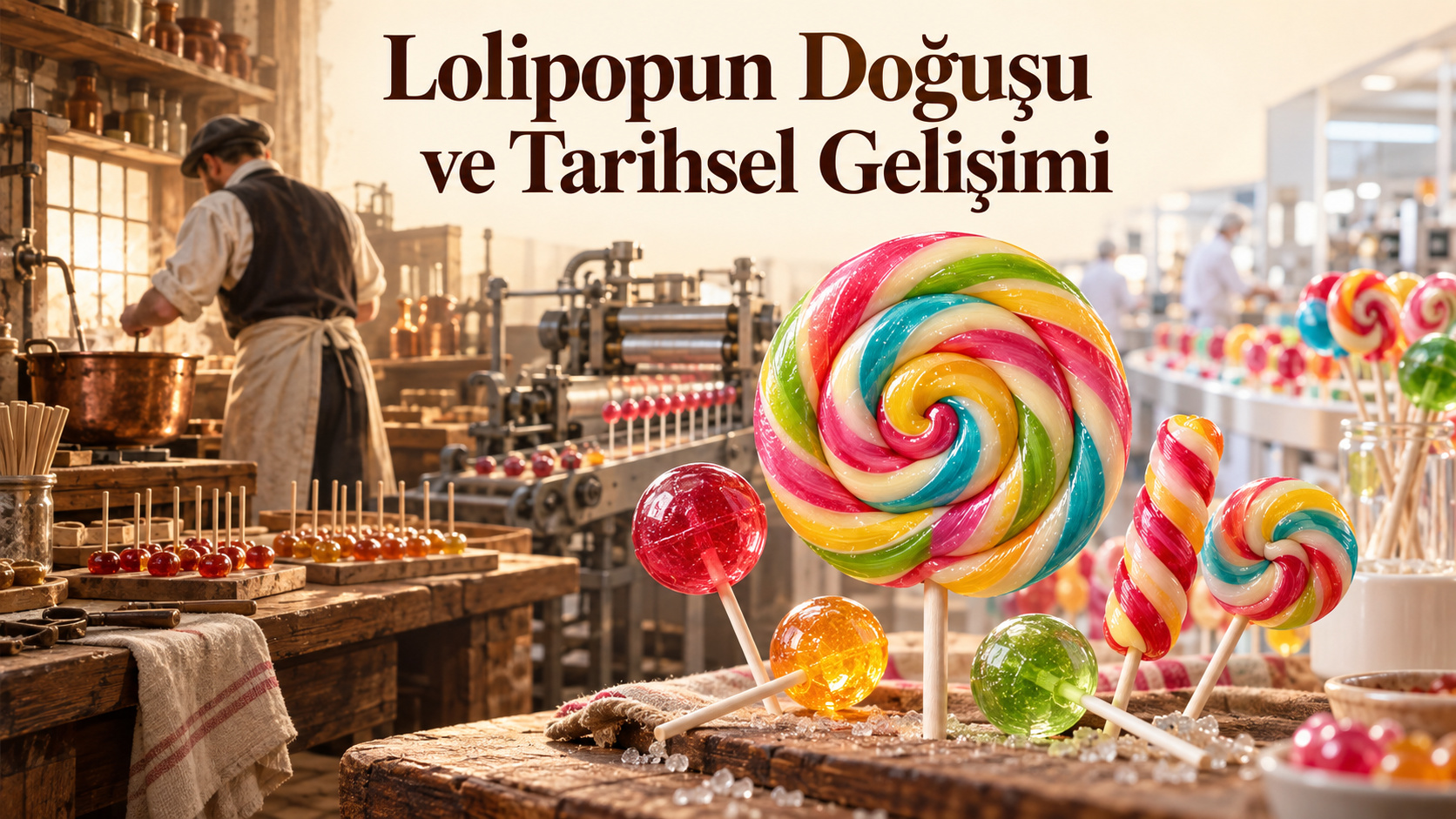
The Origin and Historical Development of the Lollipop
A lollipop is a candy attached to a stick and usually consumed by slowly sucking on it. The stick allows the candy to be eaten without needing to hold it directly with your hands. Its current colorful appearance and variety of products are the result of a long development. To understand the history of the lollipop, it is necessary to examine ancient sweet traditions, the emergence of lollipop sticks, and the development of modern production separately.
The confectionery culture is much older than the modern lollipop. In ancient Egypt, foods sweetened with honey, dates, and fruits were prepared. Sweets containing fruits and nuts show people's quest to create sweet flavors by combining different ingredients. However, it is not possible to say that today's hard candy sticks were invented at the same time as these ancient foods. The origin of confectionery and the birth of the lollipop are different historical topics. World History Encyclopedia
One of the remarkable details in the history of the lollipop is that its name was used before the modern product. The English word "lolly-pops" appears in uses dating back to 1784. At that time, the word referred to a soft candy made with molasses and sugar, some recipes also including butter and flour. Therefore, the first use of the word cannot be considered the invention date of the hard candy on a stick as we know it today. There is also no definitive explanation regarding the origin of the word. Etymology, Origin & Meaning
In the 19th century, the use of machines and molds in confectionery production changed the way products were prepared. A catalog from 1874 belonging to the Thomas Mills & Brother company, which is in the Smithsonian collections, shows confectionery machines and molds that allowed for the production of different shapes. Special machines were even designed for candies in the shape of animals, ships, and trains. These documents reveal that shape and visual appeal, in addition to taste, were important in confectionery production before the modern lollipop.
One of the most frequently mentioned names in the history of the modern lollipop is George Smith, who worked in New Haven, Connecticut, USA. The Bradley Smith Company began producing hard candy on a stick under the name "Lolly Pop" in 1908. According to the story, Smith chose the name inspired by a racehorse he saw at a fair. The "Lolly Pop" brand was registered on October 13, 1931. Smith's contribution is important in terms of the commercial development and naming of the modern lollipop. However, it would not be accurate to explain the entire history of the lollipop with the invention of a single person, as there were candies served on sticks before him.
In the widespread production, the ability to place the stick in the candy by machine was an important step. Max Buchmuller's US patent, granted on December 1, 1914, describes a system that allows the lollipop to be shaped in a mold and the stick to be placed in the candy in the mold. This document is more concerned with the development of the production method than with the lollipop itself. The fact that molding and stick placement are done within the same mechanical system is a concrete example of adapting manual processes to mass production.
The 1920s and 1930s were the years when the lollipop diversified with different brands and product structures. Dum-Dums, which emerged in 1924, was one example of this development with its small, round stick candies. Tootsie Pop, developed in 1931, placed a chocolate-flavored, chewy candy inside a hard candy. Thus, it became possible not only to change the flavor in the lollipop, but also to offer different textures between the outer layer and the inner filling. Filled products opened up new options in lollipop design. dumdumpops.com
In the mid-20th century, the lollipop found its place in everyday life as a small treat as well as a product for sale. Spangler Candy acquired the Dum-Dums brand in 1953. According to the company's history, in 1959, banks and doctors' offices began giving these lollipops to their customers and patients. In a program launched that same year, children could exchange the wrappers they collected for toys and other gifts. These practices show that the relationship between the lollipop and the consumer also developed through packaging and promotions. dumdumpops.com
Chupa Chups, born in 1958, is a significant example of the global branding of the lollipop. Its founder, Enric Bernat, placed the idea of easily eating the candy with a handle at the heart of his product. The brand's first line included flavors such as strawberry, orange, and lemon, as well as combinations like strawberry-cream and coffee-cream. Bernat's work represents the development of the already existing idea of a candy bar into a strong brand with different flavor options. Chupachups
In 1969, Salvador Dalí's design, which formed the basis of the Chupa Chups logo, is a remarkable event in lollipop history, demonstrating the role of packaging and visual identity. A candy was presented with a symbol that the consumer could recognize. With the international spread of the brand, the lollipop became similar in different countries.